
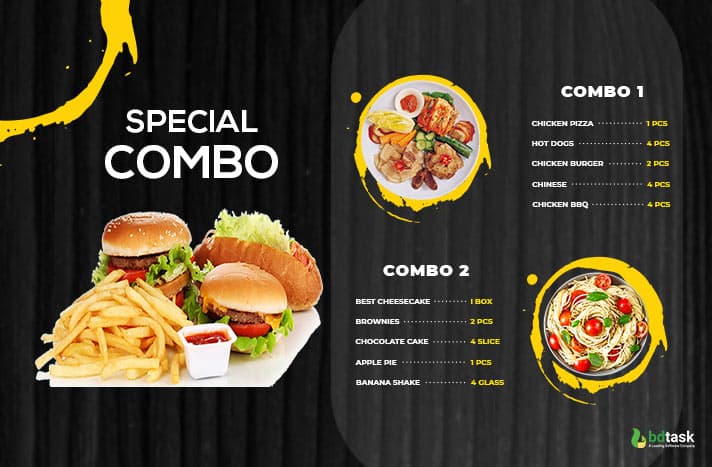
How to Build a Profitable Combo / Meal Deal
Next, create margin-friendly offers that customers actually love. Done right, bundles increase average order value, reduce decision fatigue, and make ordering faster. Done wrong, they become the classic trap: a “deal” that sells a lot but quietly destroys profit.
This matters even more when customers are value-sensitive. Industry reporting on National Restaurant Association research notes that many operators plan to offer deals/value promotions, and that operators see diners as more value-conscious right now. Restaurant Dive That means combos can be a smart move — if you engineer them with margin rules, not just discounts.
Before you build any deal, make sure your basics are solid: Food Cost Percentage Explained (and what to aim for) and How to Price a Dish: Cost + Margin + Psychology.
Combos work because they bundle “a decision” into one clear choice. PepsiCo Partners explains that combos can drive a higher check average by encouraging add-ons and can increase value perception because customers see the bundle as discounted compared to buying items separately. PepsiCo Partners
But combos fail when restaurants:
discount the wrong items (high-cost items),
ignore portion drift (the combo gets “generous” over time),
or build a bundle that sells volume but leaves too little contribution margin.
If you want to avoid the most common traps, this page pairs well with The Most Common Pricing Mistakes Restaurants Make.
When you create a combo, don’t start with the discount. Start with the math:
Contribution margin = bundle price − bundle food cost
Menu engineering frameworks repeatedly emphasize that profitability decisions require knowing item-level food costs and contribution margin (what’s left after food cost). A good overview is Lightspeed’s menu engineering guide, which frames menu engineering around cost per serving and contribution margin. Lightspeed
Simple profitability guardrail:Decide your minimum contribution margin for a combo before you choose items. Then only build deals that meet it.
Your hero should be:
popular or easy to market,
operationally stable (fast to execute),
and portionable (so cost stays consistent).
If your hero item is profitable and popular, it’s often a “star.” If you haven’t engineered your stars yet, do that first: Engineering Your “Star” Items (high profit + high sales).
The best combo sides are usually:
fries/wedges (portionable),
salad (measured),
soup (ladle portion),
small dessert (pre-portioned),
or a simple add-on that feels generous but is controlled.
This is where consistency becomes your profit engine. Portion drift inside combos is deadly because staff feel “it’s a deal, give them more.” Lock the system first with Portion Control: The Hidden Key to Better Profit.
Beverages often have strong margin and can help protect combo profitability. That’s why many operators structure combos around a drink + side + main. PepsiCo Partners specifically calls out combos as a driver of higher check average and value perception, which is often driven by exactly this structure. PepsiCo Partners
Here’s the trick: the customer needs to feel value — but you don’t always need to offer a large price cut.
Value can be created by:
convenience (“one click” ordering),
a clearer choice (“no thinking”),
or a small perceived bonus (free sauce, upgrade option, premium side add-on).
If you do discount, keep it modest and controlled. Your goal is “better deal than separate items” without turning it into a loss leader.
Calculate the bundle food cost (using your standard portions)
Set a minimum contribution margin target
Price the bundle to meet that target
Only then compare it to the “sum of items separately” and decide how much perceived discount you can show
This method prevents the most common problem: “We priced it because it felt right.”
If you want a broader operator lens on how to evaluate profitability and promote profitable items, the National Restaurant Association has a resource focused on analyzing what sells and what profits, and using that insight to adjust pricing or promotion: Increase your restaurant’s profitability potential. NRA
If your main dish is already high food cost (premium protein), don’t pair it with another high-cost component (loaded fries, big dessert) and then discount it.
Better: pair premium mains with low-cost, high-perceived-value sides — and offer upgrades (paid) rather than giveaways.
If the combo includes “choose any side,” you must control the side list or you’ll accidentally bundle your most expensive items.
Fix: define a “combo side list” with portion-controlled items only.
Sometimes the combo increases volume but cannibalizes customers who would have bought items separately at full price.
Fix: create combos that are best for:
lunch, families, or specific dayparts,
slower days,
or new-customer acquisition.
Value promos are common, but they need to tie to quality/service and repeat visits — not just lower price. That nuance shows up in the Restaurant Dive coverage of NRA insights around value and promotions. Restaurant Dive
A profitable combo isn’t just math — it’s speed and consistency.
Design combos that:
reduce decision time at the counter,
reduce customizations,
and use items that share prep steps.
This lowers labor stress and improves throughput — which indirectly increases profitability even if food cost stays the same. If you’re still working on pricing structure overall, revisit How to Price a Dish: Cost + Margin + Psychology.
Every month, review:
combo sales volume (did it truly increase AOV or just replace normal orders?)
contribution margin per combo (bundle price − bundle food cost)
portion drift signs (extra fries, extra sauce, heavier scoops)
refund/complaints (does the bundle create quality issues or delivery issues?)
If your combo becomes too popular, that’s not always good — it can expose operational weak points. That’s why combos should be built on engineered “winners” and controlled portions.
For deeper menu profitability thinking, Lightspeed’s menu engineering guide is a strong external reference because it anchors decisions in contribution margin and popularity, not intuition.